


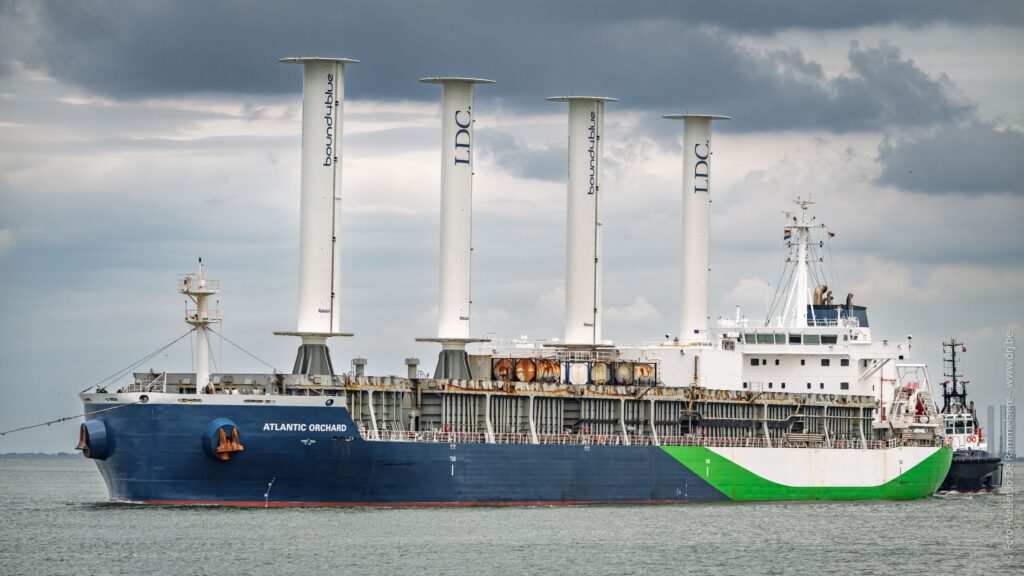
From Spain’s Cantabrian coast to Brazil’s century-old Port of Santos, the MV Atlantic Orchard sailed a one-of-a-kind course in the spring of 2025, literally harnessing the wind thanks to four eSAILs® – developed by bound4blue and the largest ever built to date.
We spoke with Fabian Kowatsch, LDC’s Shipping Decarbonization Lead, to reflect on this milestone in the Group’s history, that leverages innovation to advance LDC’s decarbonization journey.
Q
Before diving into the eSAILs® installed on the MV Atlantic Orchard, can you walk us through what decarbonization really means in practice, in ocean freight?
A
Ocean-going freight is one of the most difficult sectors to decarbonize, because it can’t be electrified, unlike road transport, and yet it requires huge amounts of energy to move ships around the globe. Despite the constraints, the industry is working hard to develop viable solutions for lower carbon maritime freight.
Today, driven by increasing investments in innovation and the commitment of highly ambitious industry players, two main pathways have taken shape to reduce emissions:
The first is making ships more efficient, reducing the amount of fuel required to operate them. You can achieve that by upgrading the engine, applying low friction hull coating, installing devices that improve water flow around the propeller, etc. Whenever we see that one of these solutions are applicable in our freight operations, we deploy them on as many chartered vessels as possible.
The second pathway is to tackle the energy source itself, by replacing the fuel oil (of fossil origin) by a more sustainable solution – for example, biofuel, green methanol… or wind! And that’s precisely where the eSAILs® project fits into our strategy.
Q
Turning to the successful installation of this wind-assisted propulsion system (WAPS) on the MV Atlantic Orchard. Looking back, how do you view this achievement, personally and professionally?
A
It’s been almost four years since the original technology scouting study in 2022, and somehow it feels like it all started yesterday.
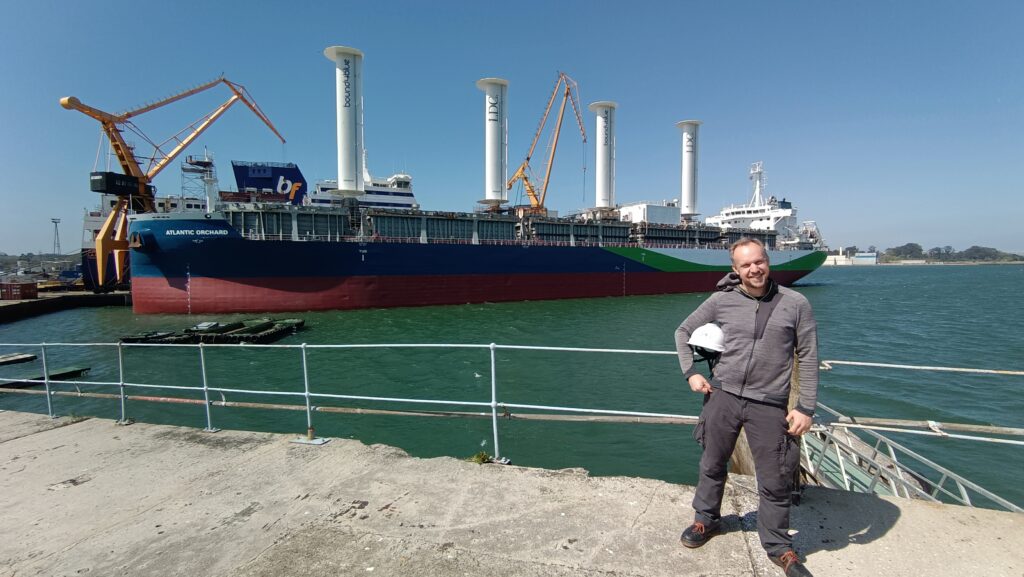
The project means a great deal to me. In fact, it probably stands out as one of the most demanding, yet fulfilling chapters of my time at LDC, as it pushed me far beyond my comfort zone, requiring me to deep-dive new and complex technical knowledge. From safety, design, engineering, naval architecture and ergonomics, to legal, insurance, logistic, regulatory and financial considerations – not to mention business projections, production, installation and quality matters. I’m probably missing a few, and the truth is, we’re still not done yet, with measurement and optimization actions still ongoing!
Looking back, the journey wasn’t always as smooth as I wished it would be. I had to deal with unexpected setbacks, navigate periods of high stress and periodically work long nights – both from the office in Geneva or literally from the middle of the ocean, while the outcome remained uncertain. But all of this is precisely what made the journey so meaningful and fulfilling.
So, back to the initial question, what does this project mean to me? I guess in a word: pride. Pride in this accomplishment, that directly contributes to our decarbonization journey. Pride in working alongside a great team of passionate colleagues, with different backgrounds and expertise, whose dedication never failed. And pride in being part of a company driven by a commitment to help shape a better maritime industry, guided by a purpose to create fair and sustainable value in all its activities.
Q
You were on board for the inaugural voyage powered by eSAILs® in 2025, crossing from Santander to Santos. Tell us about your experience of this trip.
A
Despite our eagerness to test the eSAILs®, the inaugural voyage was initially met with… no wind at all! Although this wasn’t ideal for measuring thrust, the calm conditions proved surprisingly valuable: they allowed time to run system checks, finetune minor issues with bound4blue technicians on board, and get fully familiar with the control interface and eSAILs® themselves. The crew quickly gained confidence and even offered ideas to improve the control screen.
The windless conditions at sea also allowed me to finally climb to the top of the sail, 47 meters above the water – a personal dream of mine! Securely harnessed but still with a racing heart, I was rewarded with an unforgettable view.
A few days later, the wind finally picked up, and the first real test delivered exactly what we hoped for: with the same engine settings, activating the sails gave us an immediate speed boost. It was clear proof that the technology worked and would cut both fuel consumption and greenhouse gas (GHG) emissions.
Q
Early studies anticipated double digit fuel and CO₂ reductions, subject to routing. Where do observations stand today and what is your methodology for calculating fuel savings and carbon abatement?
A
Fuel and CO₂ savings are directly linked: every ton of fuel saved avoids roughly 3.2 tons of GHG emissions. The real challenge is determining how much fuel the eSAILs® actually save.
To do this, we compare the vessel’s real-world consumption to a “no sails” scenario. That scenario is generated through a digital twin model built from the ship’s naval architecture, historical consumption data, and performance across different weather and speed conditions. By simulating each voyage as if the sails weren’t installed and comparing it with actual fuel use, we calculate the savings.
Two factors, however, complicate the picture:
- The eSAILs® are still being optimized, and therefore haven’t yet reached their full potential.
- Market conditions often require maximum speed. In those cases, the sails add thrust to shorten transit time, rather than reduce engine load, so fuel savings are smaller.
As a result, some voyages yield fuel savings above 10%, others below this threshold. These variations are largely influenced by wind conditions and operational priorities.
Going forward, as more voyages generate new data, we’ll continue improving our calculation methods and fine-tune usage of this technology and explore opportunities to expand its use. And as tuning progresses, we’re confident that we will consistently achieve double-digit reductions whenever the weather is favorable.
That’s why I consider our inaugural voyage a personal milestone, but not a conclusion – on the contrary, it was the opening chapter of an exciting story that LDC is just beginning to write, with plenty more to do and learn on the journey ahead!